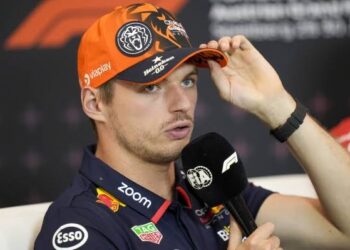
max verstappen

Shocking:Max Verstappen Confesses To Nearly ‘Destroying’ Red Bull’s Garage….

Shocking:Max Verstappen Confesses To Nearly 'Destroying' Red Bull's Garage.... Title challenger Max Verstappen, according to Lando Norris, "got a touch lucky" with a rule "no one agrees with" in winning a thrilling Sao Paulo Grand Prix from 17th on the grid. As a result, the McLaren driver's hopes of winning the championship are now in jeopardy. On lap 29, the lead changed hands as George Russell of Mercedes, who had started first, pitted behind Norris as the Virtual Safety Car period began following Nico Hulkenberg's spin. The pair's pitting strategy gave the three cars right behind them—Esteban Ocon, Verstappen, and Pierre Gasly—track position, but it quickly backfired when the Safety Car was called for worsening rain one lap later. The red flag was then raised after Franco Colapinto suffered a serious crash. Any advantage Norris and Russell might have had had the race gone on normally was nullified when the race was delayed and all drivers were free to swap tires for the Speaking to Sky Sports F1 after the race, Norris insisted when asked about the final call to stop that "I have faith in the team in what they are saying and they have trust in me." Norris had been heard discussing strategy options in the laps prior to his lap as conditions began to worsen again.

Read more
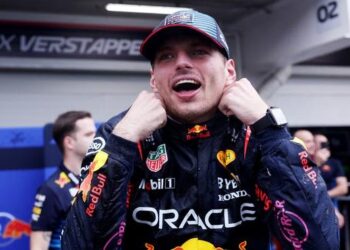
Max Verstappen’s title bid supported by eight billion laps of Las Vegas

Max Verstappen’s title bid supported by eight billion laps of Las Vegas Max Verstappen will be racing on a floodlit track that his Red Bull team has already simulated about eight billion times when he travels to Las Vegas in pursuit of a fourth consecutive Formula One championship. Verstappen would win the title with two rounds left if he won the Saturday night race on November 23 on a street track that runs along Nevada City's renowned Strip. Jack Harington, the lead of Red Bull's partnerships section, who collaborates with software behemoth and title sponsor Oracle, told me, "We run four billion simulations before we arrive at the circuit." He continued, "After that, we run those four billion simulations again using the data from FP1 and FP2 (first and second practice)." Paraphrase He emphasized that it was a billion, not a million, but because Verstappen is 62 points ahead of McLaren's Lando Norris, it is easy to predict who will win this year. "It is often claimed that you have to stretch your hand out to see if it is raining in the pitlane, but there are always going to be unexpected factors," Harington added. Paraphrase...

Read more
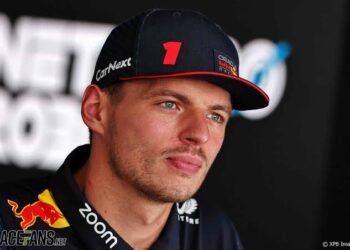
Urgent:Max Verstappen Rushed to the Hospital in a Critical Condition

Urgent:Max Verstappen Rushed to the Hospital in a Critical Condition In a historic performance, Max Verstappen ended Lando Norris' ambitions of winning the Formula One world championship by starting the race from 17th place on the grid and winning the Brazilian Grand Prix in the pouring rain. Verstappen began Sunday's round with just three cars behind him due to a subpar qualifying performance and an engine penalty. However, Verstappen took the lead on lap 43 of 69 and never looked back in the dangerous conditions to win an incredible race that puts him one step closer to winning the championship for the fourth time in a row. Paraphrase Verstappen crosses the chequered flag an incredible 19.4 seconds ahead of Esteban Ocon and Pierre Gasly, who were an unexpected second and third for Alpine, making him the first driver since Kimi Raikkonen 19 years ago to win a race from so far back on the grid. Charles Leclerc of Ferrari was one position clear of George Russell in fourth place. On a terribly dismal afternoon for the British driver in Sao Paulo, Norris, who began from pole position, finished just sixth. Paraphrase Verstappen stated, "I have a brief question," after answering a number of questions during the FIA's official media call after his victory in Interlagos. Although I am grateful that everyone is present, I do not see any British journalists....

Read more


Page 2 of 2 1 2

Connect with us

  • Trending
  • Comments
  • Latest

Title: Power Meets Precision: Rybakina vs Sabalenka in a Semifinal Showdown Introduction When two of the most formidable power hitters in women’s tennis collide, the result is rarely anything short of explosive. The semifinal clash between Elena Rybakina and Aryna Sabalenka promises exactly that—a high-stakes duel defined by big serves, baseline aggression, and razor-thin margins. With a place in the final on the line, this matchup is not just about skill, but about composure under pressure and the ability to seize critical moments. Player Overviews Elena Rybakina: Calm Efficiency and Lethal Serving Rybakina has established herself as one of the most efficient players on tour. Known for her smooth, almost effortless power, she rose to global prominence after winning Wimbledon Championships in 2022. Her game revolves around a dominant first serve, often producing free points or weak returns that she can quickly capitalize on. In recent seasons, Rybakina has maintained a strong presence in the latter stages of major tournaments, signaling consistency at the highest level. Her temperament is another key asset—she rarely shows emotion on court, which can make her particularly dangerous in tight situations. Aryna Sabalenka: Relentless Power and Competitive Fire Sabalenka, on the other hand, brings a more explosive and emotional brand of tennis. A Grand Slam champion at the Australian Open (2023), she has evolved significantly, especially in managing her once-erratic serve. Her raw power off both wings, particularly her forehand, allows her to dictate rallies and overwhelm opponents. What sets Sabalenka apart is her intensity. She thrives on momentum and can raise her level dramatically when she senses an opening. While her game can occasionally produce unforced errors, her improved consistency in recent years has made her one of the most feared players on tour. Tactical and Performance Analysis At its core, this matchup is a battle of controlled aggression versus relentless force. Rybakina’s serve will be one of the most decisive weapons on the court. If she lands a high percentage of first serves, she can keep points short and prevent Sabalenka from finding rhythm on return. Her flat groundstrokes, particularly off the backhand wing, allow her to redirect pace effectively and exploit any positional lapses. Sabalenka, however, will look to counter this by attacking second serves and stepping inside the baseline whenever possible. Her ability to take time away from opponents is crucial—if she can rush Rybakina into shorter swings or defensive positions, she gains the upper hand. Additionally, Sabalenka’s improved net play adds another layer to her attack, giving her more options to finish points. From a baseline perspective, both players prefer first-strike tennis, meaning rallies may be shorter than average. This increases the importance of serve and return efficiency, as well as the ability to convert break points—likely to be limited in number. Head-to-Head Context Their head-to-head record has been competitive in past meetings, though exact figures may vary depending on the timing of this matchup. Historically, matches between them have often been decided by small margins, with momentum swings playing a significant role. If precise statistics are unavailable, it is safe to say that neither player holds an overwhelming psychological advantage. Key Matchup Factors 1. First-Serve Percentage For Rybakina, this is non-negotiable. A high first-serve percentage allows her to control tempo and avoid extended rallies where Sabalenka’s power can take over. 2. Unforced Errors vs Winners Balance Sabalenka walks a fine line between dominance and overhitting. If she maintains discipline and keeps her error count in check, her aggressive style becomes a major asset. 3. Mental Resilience Under Pressure Semifinals bring added pressure, and both players have experienced high-stakes matches before. Rybakina’s calm demeanor contrasts with Sabalenka’s emotional intensity—either approach can succeed, but it will depend on who manages key moments better. 4. Return of Serve Breaking serve may prove difficult. The player who can generate even a slight edge on return—by neutralizing the first serve or attacking the second—could decide the match. 5. Surface Influence While the exact surface is unspecified, both players perform well on hard courts and grass, where their power games are most effective. If played on a slower surface, longer rallies could slightly favor Sabalenka’s physicality, though Rybakina’s precision still keeps her competitive. Conclusion: Who Has the Edge? This semifinal is as evenly matched as it gets—two elite players with similar strengths but different approaches to applying them. Rybakina’s efficiency and composure make her incredibly difficult to break down, while Sabalenka’s intensity and firepower give her the ability to take the match out of her opponent’s hands. That said, Sabalenka appears to hold a slight edge heading into this contest. Her recent improvements in consistency, combined with her ability to raise her level in big moments, suggest she may be better equipped to handle the pressure and dictate play over the course of a full match. Expect a tight, high-quality battle, potentially decided by a few key points. But if Sabalenka can strike the right balance between aggression and control, she is the more likely player to emerge victorious and book her place in the final.

SZOKUJĄCE ROZSTANIE

Recommended